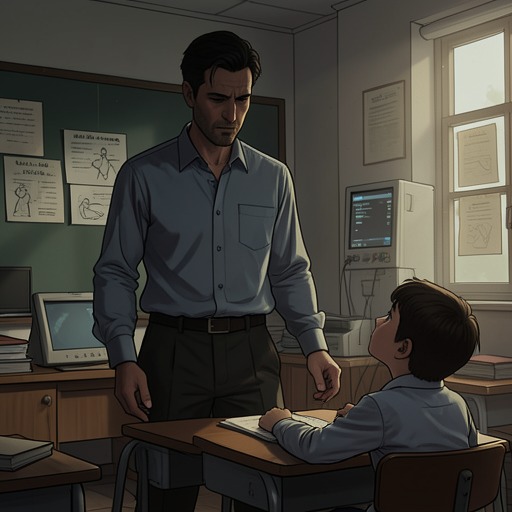
Lewiston
Hold TightLewiston is the schoolteacher at the center of a widening conflict over an affair video: first a private recording, then a source of leverage, and finally a reason Nash gives for killing two women. The account connects Lewiston to the girls’ attempt to make him pay and to Nash’s criminal acts, but it leaves a decisive question unresolved: whether Lewiston knew his confidante would turn his disclosure into violence.
Identity and Introduction
Lewiston is identified as a schoolteacher and as the man whose infidelity was recorded. The evidence gives little independent detail about his life; instead, it introduces him through the consequences of information about his private conduct passing between people. His affair becomes public not through a direct confrontation in the supplied scenes, but through a video on Yasmin’s camera phone and the later circulation of that recording.
The recording’s movement matters. It is first something Yasmin discovers while spying on Marianne, then something she discusses with Marianne, and finally a weapon the girls decide to use. Lewiston is absent from the conversation in which these steps are reconstructed, yet his reputation and suffering become the subject around which the girls’ choices, adult loyalties, and a later murder investigation converge.
The Video and the Girls’ Retaliation
Jill explains that she and Yasmin had treated spying as a game: adults concealed things, and the girls tried to find them out. In that pattern of surveillance, they saw the video on Yasmin’s phone. Yasmin asked Marianne about it. Marianne reportedly said the matter was over and that Lewiston was suffering too. This response complicates Jill’s belief that Marianne had simply arranged to expose him. The girls had seen evidence of the affair, but what Marianne intended, and how far she was involved, remained more complicated than their first interpretation.
Jill says that she and Yasmin acted on the same day, though by different means. Jill sent an e-mail about a party to make Tia act; Yasmin sent out the video to punish Lewiston for what he had done. Jill presents the actions as an effort to respond to adults who decided what was best and to the other students who had been cruel to Yasmin. Her account links the girls’ sense of exclusion to their decision to intervene, without making their actions harmless: a private recording became public, and the exposure was meant to cause consequences for Lewiston.
The distinction between the girls’ actions is important. Jill’s e-mail was meant to provoke an adult response, while Yasmin’s distribution directly targeted Lewiston. The girls describe both as limited acts, but their smallness in form does not contain their effects. A few electronic messages connect the family’s attempt to protect Adam with the wider story of the affair video and its violent aftermath.
Connection to Nash’s Murders
Later, Loren Muse and Paul Copeland discuss the killings and the tape. Muse accepts that Pietra is probably telling the truth; Paul agrees, while acknowledging that he has little basis to be certain. Their working account is that Nash killed two women to help his brother-in-law, Lewiston, by finding and destroying the recording of Lewiston’s infidelity. Reba Cordova is named as one of the women Nash tortured. The video is therefore not merely damaging evidence or a tool of humiliation: in Nash’s account of his purpose, it is the object he seeks to eliminate, and the search for it is tied to lethal violence.
That connection does not settle Lewiston’s responsibility. Paul reports that Lewiston says he confided in Nash and did not know Nash would become violent. Pietra supports Lewiston’s account, but Paul says there is not yet enough evidence either way. His uncertainty is practical as well as moral: he declines to treat a psychological explanation as something that can be prosecuted, and says the detectives must establish what the evidence can show.
Responsibility and Narrative Significance
Lewiston occupies a position between exposure and uncertainty. The girls’ account presents him as the target of deliberate retaliation for his conduct; Nash’s actions, by contrast, turn the effort to protect him into a sequence of torture and murder. Yet the narrative does not equate Lewiston’s infidelity with knowledge of Nash’s crimes. A confidence may have supplied Nash with the information and motive he used, but the evidence presented here does not prove that Lewiston intended, anticipated, or authorized the violence.
This unresolved distinction gives Lewiston’s role its weight. The video passes through acts of watching, questioning, and distribution, while each person attaches a different purpose to it: Marianne reportedly regards the matter as over, Yasmin uses the recording to punish Lewiston, and Nash seeks to destroy it. The investigation must then separate the consequences of Lewiston’s conduct from the question of his criminal involvement. His story is thus not a resolved portrait of guilt, but a test of how far responsibility can be inferred from a secret shared with someone who commits violence.